
Track record
Three records. Each one started with seeing the market before it moved.
01 · Regulators · 2011–2022
A national space radio monitoring capability, from blank page to ITU network.
8
volumes in the feasibility study
USD 20M+
programme value
1st
regulator-operated station in the Middle East
Challenge. A Middle East telecom regulator had no way to see what satellites were transmitting over its territory, and no comparable station in the region to learn from.
What I did. As sole author, I wrote the eight-volume feasibility study: mission, requirements, specifications, phased plan, costs, procedures and regulatory framework.
Outcome. A programme worth over USD 20 million, inaugurated by the ITU Secretary-General in January 2018: the first regulator-operated space monitoring station in the Middle East, part of the ITU’s international monitoring network since 2022.
02 · Go-to-market · 2020–2025
Building a space business inside the world’s largest cloud provider.
$3.8M
2021
$40M+
2024
10×
in four years
Challenge. Space companies in Europe, the Middle East and Africa saw the cloud as IT, not as part of their missions.
What I did. At AWS I led Aerospace and then the Space Economy for EMEA: go-to-market strategy, partner-led motions, C-level engagement across aerospace, defence and institutions, and a team of twelve sales professionals and solution architects.
Outcome. The cloud became a primary partner for EMEA space players, with programme partnerships across ground systems, Earth observation data pipelines and mission operations.
03 · Foresight · 2013 → today
Since 2013 I have described where spectrum monitoring had to go. The industry has followed.
In SatMagazine in 2013 I argued that every nation should run its own space monitoring station. In ITU News and Satellite Pro Middle East in 2019 I argued that fixed sites would no longer be enough once constellations scaled up.
WHAT I SAID IN 2013
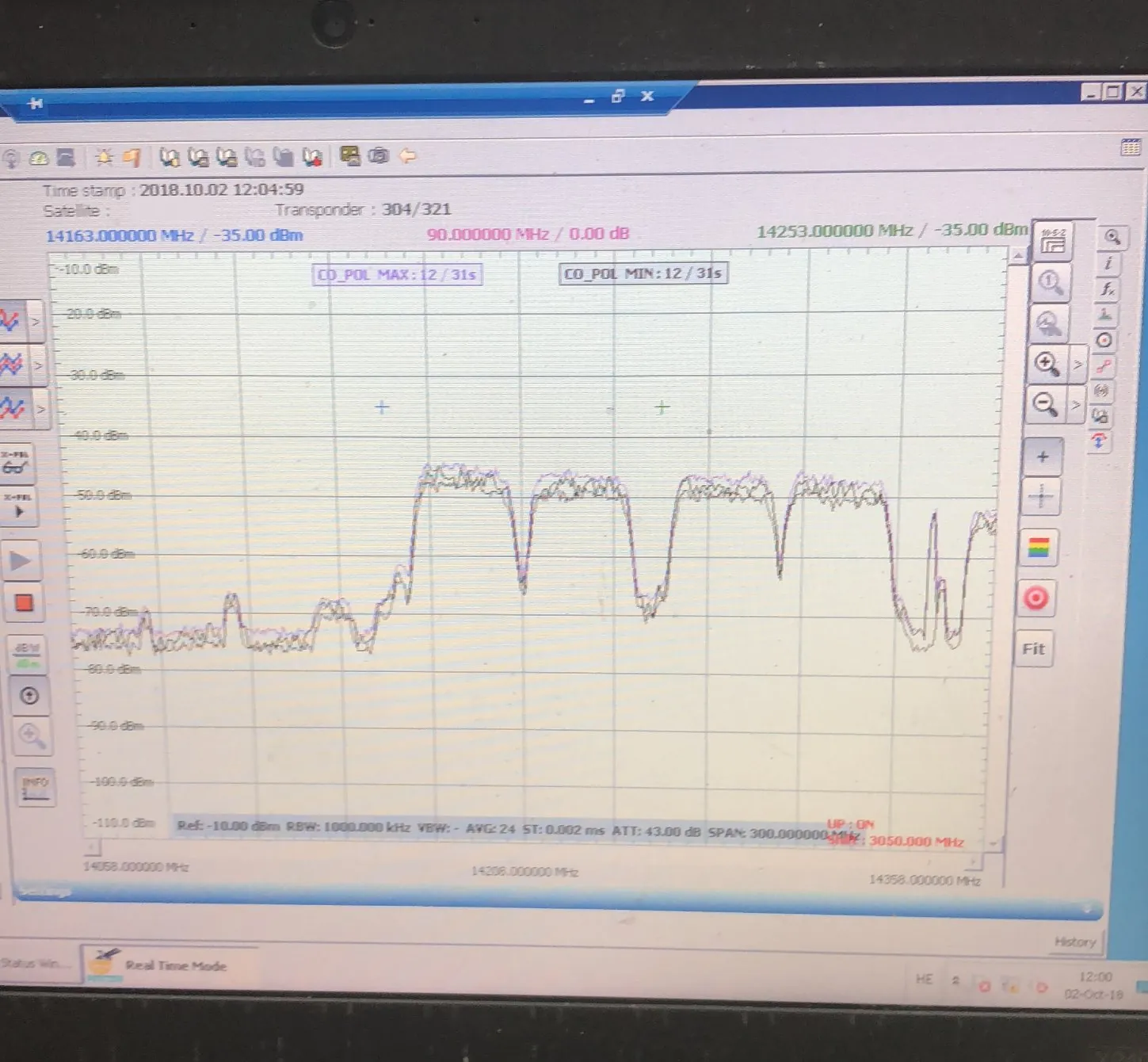
Every nation should run its own international monitoring station, with the same commercial tools satellite operators use: “If private companies can afford it, so too can the frequency regulator.” At the time, the ITU listed seven such stations.
WHAT HAPPENED
In 2018 Oman opened the first regulator-operated station in the Middle East, built largely on commercial equipment. By 2022 the ITU had space monitoring agreements with eight administrations.
WHAT I SAID IN 2019
“Basic fixed radio-frequency measurement sites are no longer enough.” Mobile, airborne and scalable sensors would be needed, with Doppler compensation and precise time-stamping.
WHAT HAPPENED
Distributed sensor networks for constellation monitoring are now on the market, and in December 2025 South Korea’s regulator adopted the first NGSO regulatory monitoring system.
WHAT I SAID IN 2019
Verifying compliance with ITU limits for constellations would be especially hard, and spectrum must stay strictly coordinated: deregulation would be harmful.
WHAT HAPPENED
WRC-23 revised the EPFD limits that protect geostationary services from constellations, and compliance checks are now a core feature of NGSO monitoring systems.
WHAT I SAID IN 2019
“Machines will have to support these operations”: data volumes would require automation, AI and closer cooperation between administrations.
WHAT HAPPENED
Automated detection and analytics are standard in new monitoring systems, and the ITU’s network of cooperating space monitoring stations keeps growing.
In print and on stage
Selected publications and appearances
2026
Speaker, World Space Business Week, Paris
2026
Panellist, New Space Economy 4 Business, Milan
2019
“Emerging challenges for satellite spectrum monitoring”, ITU News Magazine
2019
“LEO/GEO interference: how to address this”, Satellite Pro Middle East
2013
Executive Spotlight, SatMagazine: why every nation needs its own space monitoring station